


Every loan application carries a processing cost. For lenders, that cost is often measured in obvious terms: employee hours, operational expenses, and the technology required to process applications. But there is another cost that is easier to overlook.
The time spent on routine processing also takes away capacity from the people responsible for making important credit decisions.
A few minutes of manual work may not seem significant on a single application. Across thousands of applications, however, those minutes can become a substantial operational burden.
Where the Hidden Cost of Manual Loan Processing Builds Up
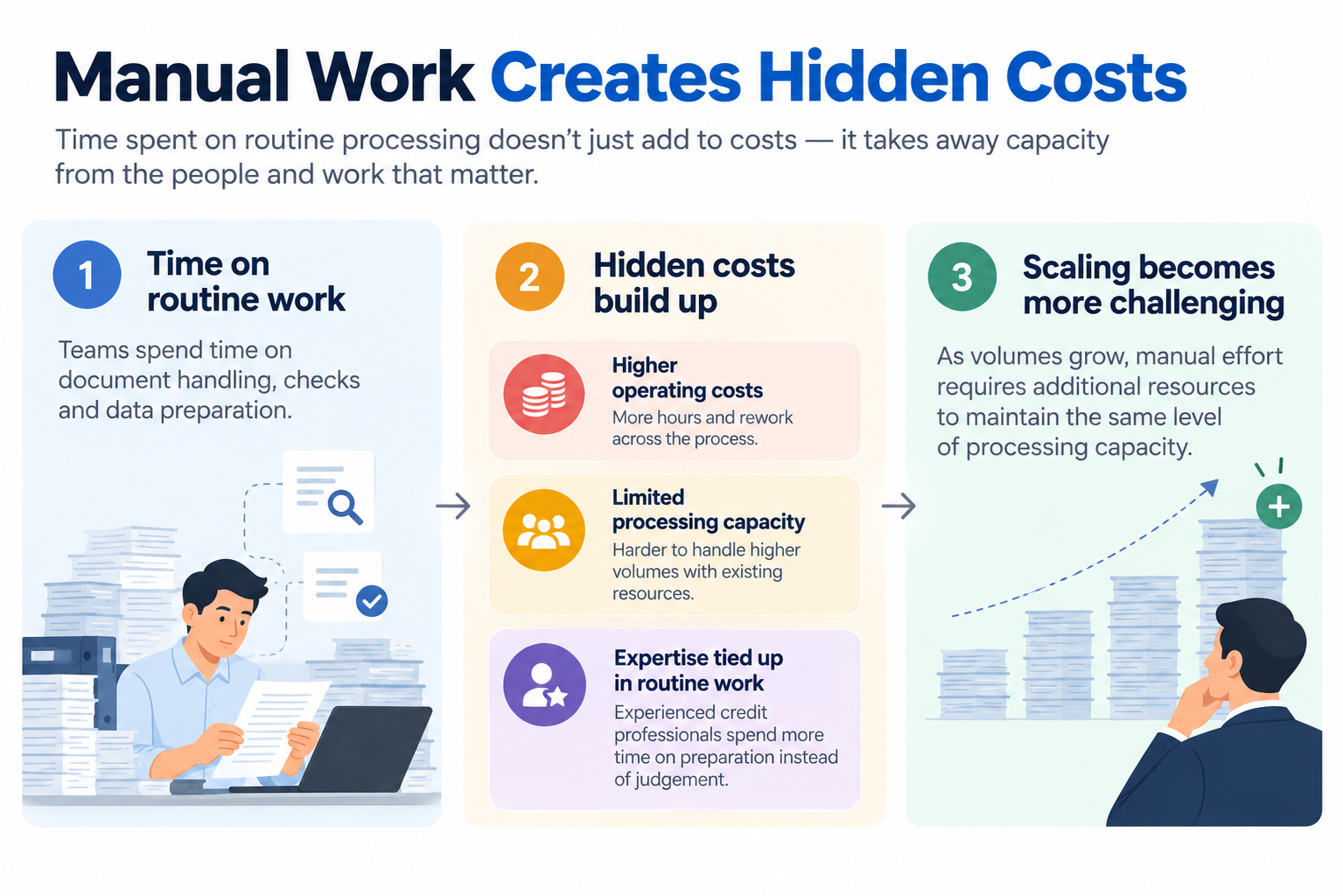
The real cost of manual processing is not simply the number of minutes spent on each application. It is what those minutes prevent a lending team from doing.
Underwriters may spend time preparing information instead of evaluating risk. Operations teams may spend time reconciling records instead of supporting customers. Experienced credit professionals may become bottlenecks as application volumes increase.
This creates several layers of cost:
- Labour Cost – Hours spent reviewing documents, entering information, and checking financial details.
- Rework Cost – Additional time spent correcting missing, inconsistent, or unclear information.
- Capacity Cost – Limited ability to process higher application volumes with existing resources.
- Expertise Cost – Credit professionals spending valuable time on preparation and routine checking rather than professional judgement.
- Scalability Cost – Additional lending volumes requiring additional operational resources.
The important point is that these costs are connected. As manual effort increases, operational capacity becomes harder to scale without increasing resources.
Document Review Takes More Than Just Reading
Supporting documents provide much of the information needed to assess a borrower.
Someone needs to locate the relevant figures, check that required information is present and compare details across documents where necessary.
When this process is handled manually, the time adds up with every application.
For example, financial statements, identification documents, income records and other supporting documents may need to be reviewed before the relevant information is ready for assessment.
Automated document extraction and verification can reduce some of this routine work by helping lenders organise information before it reaches the assessment stage.
The benefit is not simply faster document handling.
It is about getting relevant information into the hands of credit teams in a more usable form.
Preparing Information Can Become a Bottleneck
The final credit decision may take only a limited amount of time.
Getting the information ready for that decision can take much longer.
Credit analysts and operations teams may need to gather records, check figures, compare information and resolve inconsistencies before an underwriter can properly assess the application.
This creates a gap between having a decision to make and having the information required to make that decision.
When application volumes increase, this preparation work can become a significant bottleneck.
The result is that experienced credit professionals may spend more time waiting for information or reviewing prepared information and less time focusing on cases that require deeper judgement.
What Does One Application Really Cost?
Staff time provides a useful starting point for understanding the cost of manual loan processing.
Cost per application = Processing time × Hourly staff cost
This calculation can include:
- Document handling
- Information entry
- Verification
- Internal reviews
- Follow-ups
- Preparation for underwriting
- Rework caused by missing or inconsistent information
Consider a lender processing 10,000 applications a year.
If each application requires an additional 20 minutes of manual work, that represents more than 3,300 hours of staff time annually.
The actual financial impact depends on the people performing the work and their associated costs.
But the principle is straightforward: small amounts of manual effort can become significant when multiplied across a large lending portfolio.
And the cost is not limited to salary. It also represents credit capacity that could otherwise be used for higher-value activities.
Higher Application Volumes Increase the Pressure
Manual processes become more challenging as lending volumes increase. More applications mean more documents to review, more information to verify and more cases requiring specialist attention.
At some point, lenders may need additional resources simply to maintain the same processing capacity. But adding more people does not necessarily solve the underlying problem.
Experienced underwriters have limited time for detailed credit assessment. When more of that time is spent preparing information or performing routine checks, less capacity remains for complex applications where professional judgement matters most.
Repeated Checks Create Operational Friction
The same information can pass through several stages of the lending process. A document reviewed during one stage may need to be referenced again later. Differences between records may trigger another round of checking. Information may also need to be reconciled when multiple systems or teams are involved.
Each individual check may appear reasonable. The challenge is what happens when these checks are repeated across thousands of applications.
More preparation creates more opportunities for delays. More manual intervention creates more opportunities for inconsistency. And more operational effort is required to keep information aligned throughout the lending lifecycle. This is why improving lending efficiency is not simply about automating one isolated task. The bigger opportunity is to reduce the amount of manual effort surrounding the credit decision.
Looking Beyond the Cost per Application
For lenders, the cost of manual loan processing should therefore be viewed from a broader perspective. It is not only the cost of employee time.
It is also the capacity consumed by document handling, information preparation, repeated verification and rework.
A lender processing a small number of applications may be able to absorb this effort. At higher volumes, however, the same manual activities can place increasing pressure on operational teams and experienced credit professionals.
This creates a clear business question:
How much of the lending team’s time is being spent preparing information, and how much is being spent making decisions?
From Processing More to Making Better Use of Credit Capacity
Loan automation is often discussed in terms of processing applications faster. But speed is only part of the business case. The greater opportunity is to create a lending process where routine information handling is reduced, relevant information is more consistently prepared, and credit teams can focus more of their time on assessment and judgement.
SYNERGi Credit Intelligence Suite brings together capabilities designed to support different stages of the credit lifecycle, from document processing and information preparation to credit assessment and monitoring. By connecting these capabilities, lenders can look beyond automating individual tasks and consider how information moves throughout the lending process.

The Takeaway
The hidden cost of manual loan processing is not simply the number of hours spent on each application.
It is the credit capacity consumed by routine work.
When application volumes increase, even a small amount of manual effort can translate into thousands of hours of additional work. More importantly, it can reduce the time experienced credit professionals have available for the decisions that require their expertise.
For lenders, the opportunity is therefore not simply to process more applications.
It is to reduce routine processing effort, make better use of existing capacity, and give credit teams more time to focus on the decisions that matter.