


Global trade volumes continue to shift year by year, influenced by supply chain changes, trade policies, and evolving demand patterns. According to the World Trade Organization global trade in goods and services reached $34.65 trillion in 2025, with merchandise trade at $26.26 trillion and services at $9.56 trillion, reflecting approximately 7% year-on-year growth. At the same time, forecasts indicate uneven growth trends, with merchandise trade expected to moderate in the coming years due to economic and policy factors. Within banks, this translates into higher volumes, tighter processing timelines, and increasing operational complexity. The ability to manage this consistently depends on how adaptable the underlying trade finance platform is.
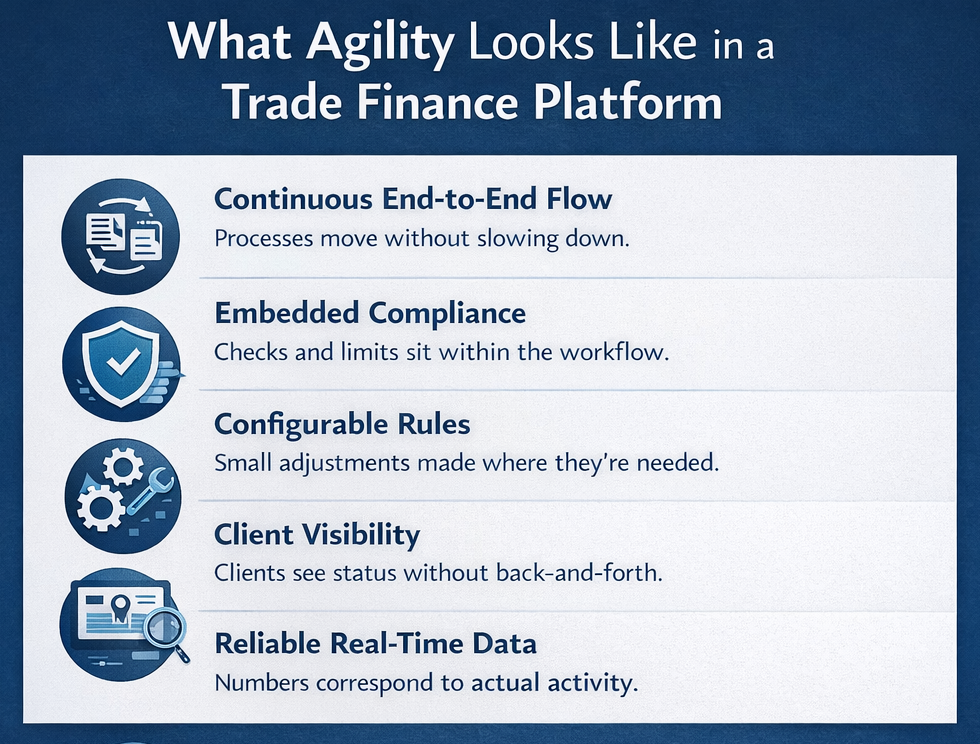
1. End-to-End Flow
Most platforms can demonstrate a full trade lifecycle. Issuance, amendment, negotiation, and settlement are all supported. What matters more is how these pieces connect during the day. In some environments, the steps feel separate. A transaction moves forward, then pauses. Someone needs to check, confirm, or push it along. Nothing is technically wrong, but the process does not feel continuous.
In others, the flow is more natural. One step moves into the next without much intervention. Documents pass through checks, and only exceptions are surfaced. Teams do not spend time thinking about where the transaction is. They focus on completing it. This difference becomes more noticeable when volumes increase. The system either keeps up, or small delays begin to accumulate.
2. Compliance and Risk Controls
Compliance is always part of trade finance, but how it sits within the process makes a difference. In some setups, checks are handled separately. A transaction reaches a point, then waits for screening or approval before moving again. This creates a stop-and-start rhythm.
In other setups, compliance runs within the process. Sanctions screening, limits, and approvals happen as the transaction progresses. There is no separate pause. This also affects how audit trails appear. In some systems, teams still need to piece together what happened. In others, the sequence is already clear because everything is captured as part of the flow. Over time, this influences how confidently teams move through transactions.
3. Configuration
Changes are part of daily operations. They are rarely large or complex. More often, they are small adjustments. A pricing change for a specific client. A validation rule added due to a regulatory update. A variation in how a product is structured. In systems that depend on development cycles, these changes tend to wait. Teams work around them using spreadsheets, manual notes, or temporary fixes.
In more flexible systems, the change is made where it is needed. A rule is updated, tested, and applied. The process continues without disruption. This may not stand out immediately, but over time it affects how quickly the bank responds without building operational workarounds.
4. Client Visibility
Clients do not usually comment on systems directly, but their behavior reflects their experience. When visibility is limited, the pattern is familiar. Emails asking for status. Calls to check progress. Uncertainty about where things stand.
When the platform provides clear updates, this changes. Clients log in, check status, upload documents, and move on. The interaction becomes routine. This also reduces the load on internal teams. Relationship managers and operations staff spend less time responding to status queries. The conversations shift to more meaningful areas.
5. Reporting and Data
Reporting often shows how closely the platform reflects actual operations. In some environments, data needs to be extracted and adjusted before it becomes useful. Numbers exist, but they need explanation.
In others, the data already reflects daily activity. Exposure, utilization, and pipeline figures match what teams are seeing. This becomes clear during internal discussions. Either the numbers are questioned, or they are used directly. Over time, consistent data makes it easier to understand patterns in trade activity.
In practice, platforms like SYNERGi Trade Finance are used to support the full lifecycle of trade transactions, from issuance through to settlement and monitoring. The value is not in changing how trade finance works but in allowing teams to manage that process with more clarity and consistency as volumes grow.
If you would like to see how it works in practice, you can explore SYNERGi Trade Finance or book a demo to learn more.